
Current numbers, October 26, 2026
Condos listed on the MLS right now, refreshed every six hours.
| Neighborhood | For sale | Median asking | Median $/sq ft | For rent | Median rent |
|---|---|---|---|---|---|
| Century City | 51 | $2.29M | $1,194 | 22 | $12,500/mo |
| Westwood | 122 | $1.07M | $739 | 101 | $5,495/mo |
| Sherman Oaks | 73 | $649K | $512 | 36 | $3,777/mo |
Medians appear only when enough listings publish the figure; a dash means too few to report. Full neighborhood reports
If you are 55 or older and selling a Los Angeles house to buy a condo, Proposition 19 lets you carry your Proposition 13 taxable base value to the new home anywhere in California, up to three times. Buy for more than you sold for, and only the difference between the two prices is added to that base.
The half of Prop 19 that helps a buyer
Proposition 19 passed in November 2020, and its base-value transfer rules took effect on April 1, 2021. The measure is discussed mostly for what it took away, namely the narrowing of the parent-child exclusion, which we cover at /blog/prop-19-inherited-la-condo-property-tax.
The other half did the opposite. It widened a benefit that already existed for older homeowners who move. Under the prior rules, Propositions 60 and 90, a homeowner 55 or older could transfer a taxable base value once, only into a replacement of equal or lesser value, and only within the same county or one of the small number of counties that had agreed to accept transfers from elsewhere. Proposition 19 removed the geographic limit, raised the count to three, and wrote a formula for buying up.
For an owner sitting on a Los Angeles house bought decades ago, that is the difference between downsizing into a condo and being taxed as though you had never owned property before.
Why the tax bill, not the price, is what blocks the move
Proposition 13 assesses property at its value when you acquire it and caps growth in that assessed value at 2 percent a year. An owner who bought in the 1980s or 1990s is very likely paying tax on a base far below what the house would sell for today.
Sell that house and buy a condo with no base transfer, and the condo is assessed at its purchase price. The real cost of the move is then not the gap between the two sale prices. It is the gap between the two tax bills, and on a long-held Los Angeles house it can be larger than the HOA dues on the new home. That arithmetic is a significant part of why so many long-tenured owners stay in houses that no longer suit them.
How a condo is taxed here more generally, including supplemental bills and Measure ULA, is at /blog/la-condo-property-taxes-prop-13-measure-ula.
Who qualifies, and how many times
Three groups can use the transfer: a homeowner who is 55 or older, a homeowner who is severely and permanently disabled, and a victim of a wildfire or a governor-declared disaster. Only one spouse or co-owner needs to satisfy the age test.
Both properties must be your principal residence, the original at the time of sale and the replacement after purchase, and both must qualify for the homeowners' exemption or the disabled veterans' exemption. A rental or second home does not qualify on either end of the transaction.
The transfer may be used up to three times. Disaster victims are not held to that limit.
The two-year window runs in both directions
The replacement home must be purchased or newly constructed within two years of the sale of the original. That window runs both ways: buying the condo first and selling the house afterward is permitted, provided the two events fall within two years of one another.
This matters more than it sounds, because buying first is usually the easier sequence for a downsizer who would rather not move twice or rent in between. Confirm the ordering and the dates with the county assessor rather than assuming them.
When the condo costs more than the house sold for
Proposition 19 does not cap the purchase price. It applies a formula instead.
If the replacement is of equal or lesser value than the price the original sold for, the taxable base value transfers unchanged. If the replacement costs more, the excess is added to the transferred base.
Suppose, purely as an illustration with round numbers and not figures from any actual sale: a house with a taxable base of $300,000 sells for $1.6 million, and the owner buys a condo for $1.9 million. The new taxable base becomes $300,000 plus the $300,000 of excess, so $600,000 rather than $1.9 million. At Proposition 13's 1 percent base rate, the difference between being assessed on $600,000 and on $1.9 million works out to roughly $13,000 a year before voter-approved local add-ons, and it recurs for as long as the condo is held.
Run that same arithmetic with your own assessed value from the county before planning around it.
Filing is a separate step, and it falls to you
The benefit is not applied automatically. It is claimed on form BOE-19-B, filed with the assessor of the county where the replacement home sits.
File within three years of purchasing or completing the replacement to receive the relief across that whole period. A claim filed later is generally applied going forward instead of retroactively, so a missed deadline costs the years already elapsed rather than the benefit itself. Forms and deadlines change, so confirm the current requirements with the Los Angeles County Assessor rather than with a listing agent or a forum post.
What it changes about shopping for the condo
Removing the county line changes the search, not just the budget.
An owner selling elsewhere in the state can buy in Los Angeles and keep the base. An owner selling a Los Angeles house can buy anywhere in California and keep it. Within the city, the practical effect is that a downsizer can choose a building on its merits, meaning dues, reserve funding, elevator count and whether the balcony inspections have been done, rather than on which side of a county line the address happens to fall.
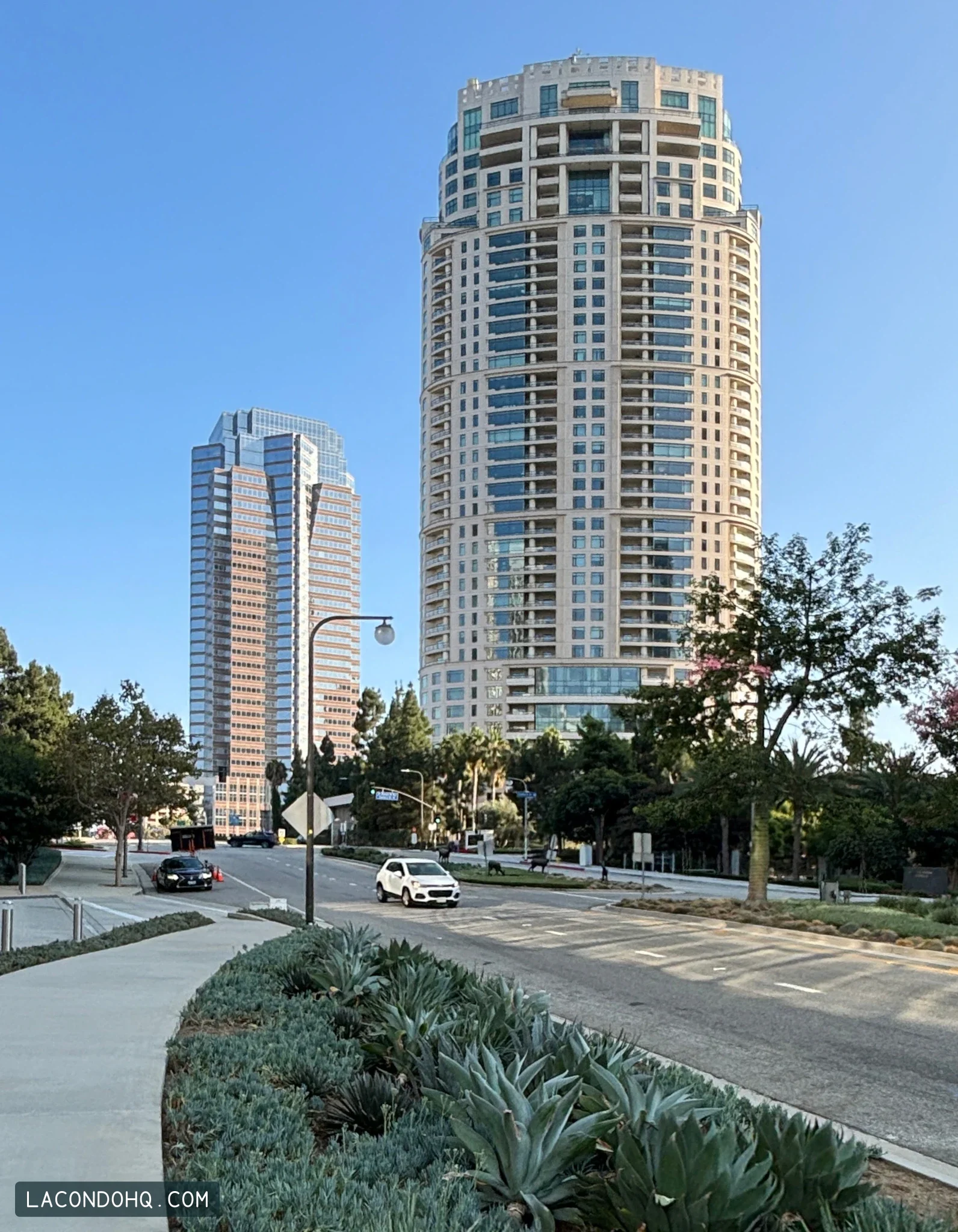
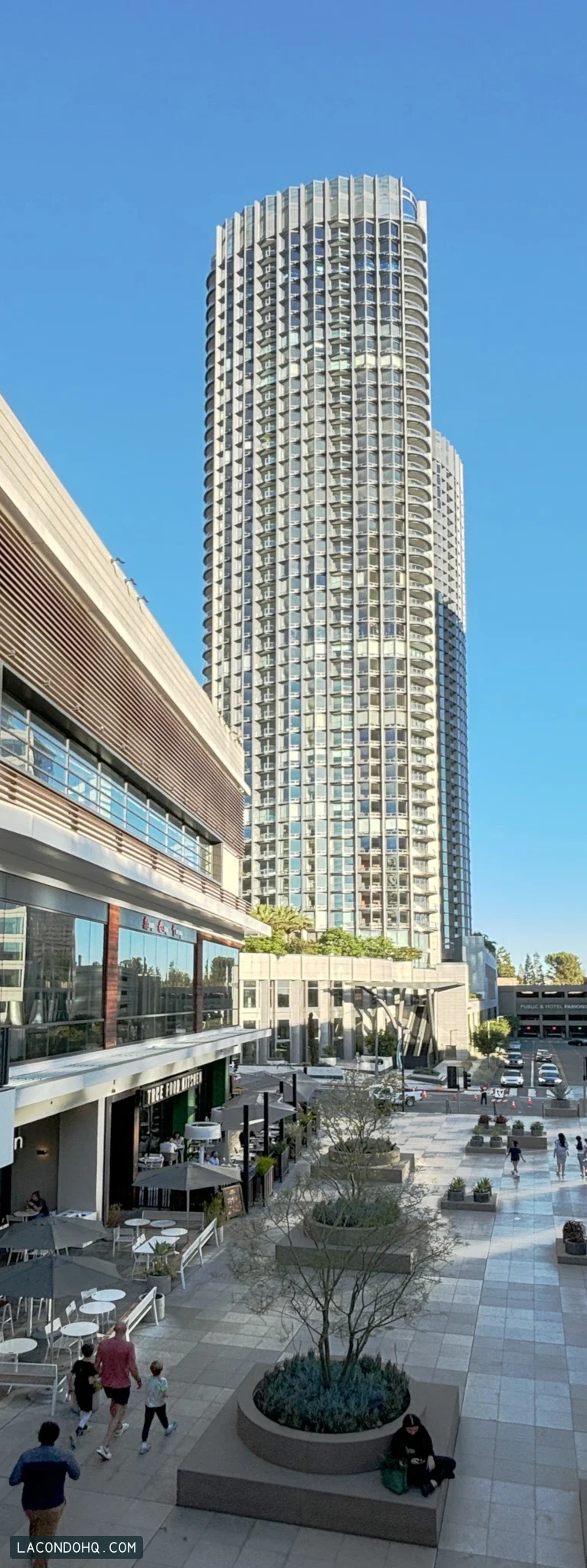
Neighborhoods that tend to draw downsizers out of Westside houses include /neighborhoods/century-city, /neighborhoods/westwood and /neighborhoods/sherman-oaks. Full-service buildings of the type those buyers look at include /buildings/the-century, /buildings/wilshire-terrace and /buildings/park-elm-at-century-plaza-i. Current asking prices are at /condos-for-sale, and dated market figures carrying their own as-of date are at /market-stats.
Two cautions specific to condos. HOA dues are untouched by any of this, and a lower tax bill can be absorbed entirely by dues on a full-service building, so read the reserve study before assuming a net saving, using /blog/la-condo-reserve-study-percent-funded as a guide. And a sale above the Measure ULA threshold carries the city transfer tax on the selling side regardless of what happens to your base.
Questions LA condo downsizers ask about Prop 19
Can I keep my Prop 13 tax base if I sell my house and buy a condo?
Yes, if you are 55 or older, severely and permanently disabled, or a disaster victim, and both homes are your principal residence. The transfer is claimed on form BOE-19-B with the county assessor and may be used up to three times.
Does the condo have to cost the same as or less than the house I sold?
No. Under Proposition 19 you may buy at any price. If the replacement costs more, only the difference between the two prices is added to your transferred base value, rather than the full purchase price being reassessed.
Can I move to a different county and keep my base?
Yes. Proposition 19 permits the transfer anywhere in California, which Propositions 60 and 90 did not. That change took effect on April 1, 2021.
How long do I have between selling and buying?
Two years, in either order. You may buy the replacement before selling the original, provided both transactions fall within two years of each other.
Does this apply to a condo I inherited?
No. That is the other half of Proposition 19 and it works differently, generally requiring the heir to occupy the property as a principal residence to keep any exclusion. See /blog/prop-19-inherited-la-condo-property-tax.
What we can and cannot tell you
Our directory tracks Los Angeles buildings, neighborhoods and pricing. It does not hold your assessed value, your filing history, or any indication of whether a particular transfer will be approved. Those sit with the Los Angeles County Assessor.
This is general information current as of August 27, 2026, and not tax or legal advice. Rules, forms and deadlines change. Confirm your own position with the county assessor and a California tax professional before making a move that depends on the outcome.
We are a research and listings platform, not a brokerage. We do not list on the MLS, negotiate offers or close transactions. When you are ready to see specific buildings, we introduce you to a licensed partner agent.
Written by
Publisher and editor, LA Condo HQ
LA Condo HQ is published by Eltherion, LLC. This article is not reviewed by a licensed real estate agent or broker and is not professional advice.



,_Avenue_of_the_Stars_(Century_City)_Sept._2024.jpg)
_from_Westfield_Century_City.JPG)