Guides

Reading an LA Condo Reserve Study: What Percent Funded Means

California associations must inspect their major components every three years and disclose a percent funded figure every year. What that ratio is actually measuring, and why the component list underneath it matters more than the headline number.

LA Condo HQLA Condo HQ
August 18, 20266 min read
Reading an LA Condo Reserve Study: What Percent Funded Means

California requires a condo association to inspect its major components at least every three years, update the reserve study annually, and hand owners an Assessment and Reserve Funding Disclosure Summary with the budget. The figure to find on that form is percent funded: reserves actually on hand, divided by what the study says should be on hand by now.

The three documents the law actually requires

Davis-Stirling splits reserve information across three deliverables, and buyers routinely ask for one and think they have the set.

The first is the reserve study itself. Civil Code section 5550 requires the board to cause a study of the association's reserve account requirements at least once every three years, based on a visual inspection of the accessible areas, covering the major components the association must repair or replace that have a remaining useful life of less than 30 years. Between studies the board must review it annually and consider adjustments.

The second is what section 5565 says the study must contain: an identification of those components, the remaining useful life of each, the estimated cost to repair or replace each at the end of that life, the annual contribution needed to defray those costs, and a reserve funding plan.

The third is the summary, and it is the one you can read in two minutes. Section 5570 sets out an Assessment and Reserve Funding Disclosure Summary on a prescribed form, distributed with the annual budget report that section 5300 requires 30 to 90 days before the fiscal year ends. It states whether the study rested on a physical inspection within the past three years, the estimated replacement cost, the accumulated reserves, the percent funded, and whether the board anticipates a special assessment within five years.

Percent funded, and the arithmetic behind it

Percent funded compares two numbers. The numerator is what is actually in the reserve account. The denominator is the fully funded balance: for each major component, the share of its replacement cost that has already been consumed by age, added up across the building.

A roof with a 20-year life, ten years old, costing $500,000 to replace, is halfway through that life, so $250,000 of it should already be saved. Do that for every component and you have the denominator. An association at 100 percent funded has not banked the full cost of every future replacement — it has savings that match the wear that has already happened, which is why a large reserve balance in a large older building can still be a thin one.

Two qualifications matter. The study rests on assumptions about component lives, inflation and interest, and different analysts make different ones. And it is not an audit: nobody opens a wall, and no third party verifies the numbers.

What a thin number predicts, and what it does not

Practitioners sort funding into bands: under roughly 30 percent thin, 30 to 70 percent middling, above 70 percent strong. Those bands are industry convention rather than statute — no California law makes a particular percentage compliant or non-compliant.

What the number predicts is the probability of a special assessment or a dues increase, not its certainty or its size. A building at 25 percent funded with a new roof, rebuilt elevators and no exterior work due for a decade sits differently from one at 25 percent with a 30-year-old roof. The percentage is the headline; the component table underneath it is the story.

What it cannot tell you is how the board behaves. An association that has held near 40 percent for a decade while raising dues methodically reads identically, on this form, to one that fell from 80 to 40 in three years. Only the minutes separate them.

The five-year question the board has to answer in writing

The disclosure summary asks the board directly whether it anticipates levying a special assessment within five years, and requires an answer. A yes is useful. A no beside a thin percentage and a component list full of items at the end of their lives is more useful still, because it tells you what the board believes — and belief is checkable against the minutes.

What a board can do without you is bounded: under section 5605 it generally cannot raise regular assessments by more than 20 percent, or levy special assessments totalling more than 5 percent of gross budgeted expenses, in a fiscal year without member approval, subject to an emergency exception. The mechanics are at /blog/la-condo-special-assessments-5-percent-rule.

Where reserve money is allowed to go

Reserves are not a general fund. Section 5510 requires board approval by majority vote at an open meeting for withdrawals from the reserve account, and section 5515 lets a board temporarily transfer reserve money to meet short-term cash-flow needs, with the reasons recorded in the minutes and the money restored within a year, subject to the narrow exceptions the statute spells out.

Repeated transfers are a signal, as are withdrawals for items that never appear on the component list. Both surface in minutes long before either moves a percentage.

Reading the study against the building in front of you

In Los Angeles two other obligations sit on top of the reserve question, and both cost money a study ought to contemplate: the inspection requirement for exterior elevated elements, at /blog/sb-326-balcony-inspection-la-condos, and seismic retrofit, at /blog/la-seismic-retrofit-condo-buyers, which applies to specific structural types the city has ordered strengthened. For each, ask whether the component list includes the work it implies, or whether the study predates the requirement entirely.

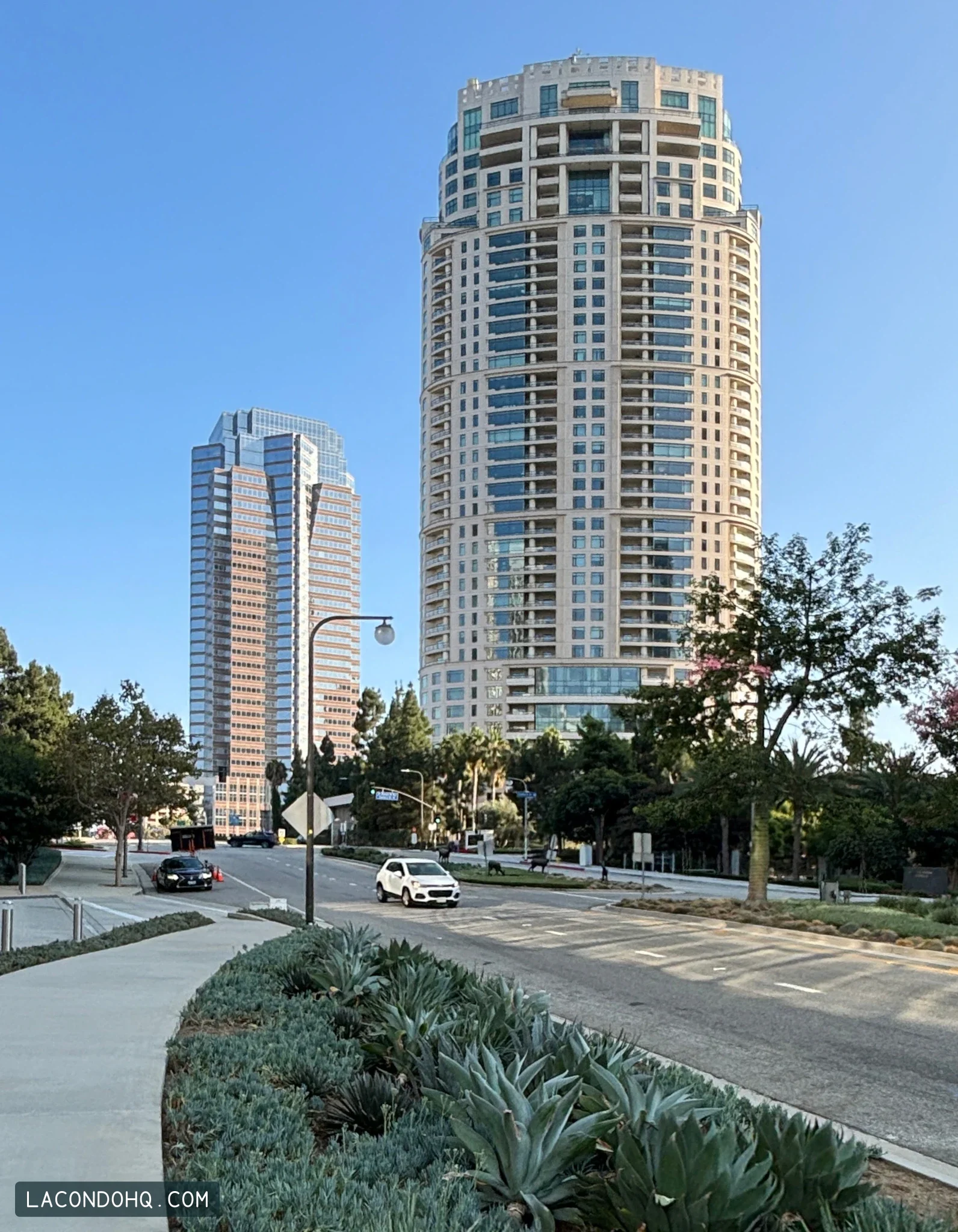
Then match the study to the stock. A Wilshire Corridor tower such as /buildings/ten-five-sixty or /buildings/the-wilshire carries a different component set — central mechanical plant, facade, elevators, subterranean garage — from a newer building with fewer shared systems. Older stock concentrates in /neighborhoods/koreatown and /neighborhoods/mid-wilshire, newer high-rise stock in /neighborhoods/downtown-la, and that difference drives much of why dues vary so widely, which we cover at /blog/la-condo-hoa-fees-explained. The documents themselves reach you in the seller's package under section 4525, detailed at /blog/hoa-resale-package-la-condo.

Questions LA condo buyers ask about reserve studies

How often must a California HOA do a reserve study?

At least once every three years the board must cause a study of the association's reserve requirements, based on a visual inspection of the accessible areas, under Civil Code section 5550. Between studies the board must review it annually and consider adjustments.

What does percent funded mean on an HOA disclosure?

It is the reserve balance divided by the fully funded balance — the share of each major component's replacement cost that its age has already used up, summed across the building. At 100 percent, savings match accumulated wear. At 50 percent, half of the wear that has already occurred is unfunded.

Is a 30 percent funded condo association bad?

Not automatically, and no California statute sets a minimum. Practitioners treat under roughly 30 percent as thin, but the component table matters more than the ratio: a thin percentage with everything recently replaced is a different risk from the same percentage with a roof and elevators at the end of their lives.

Where do I find the percent funded figure?

On the Assessment and Reserve Funding Disclosure Summary required by Civil Code section 5570, distributed with the annual budget report 30 to 90 days before the end of the fiscal year. The same form states the estimated replacement cost, the accumulated reserves, and whether a special assessment is anticipated within five years.

What to do with the number

Ask for three things together: the disclosure summary, the reserve study behind it, and the last two years of minutes. Read the percentage, then the component list, then what the board has been saying about the building. Where the three agree you have a picture; where they disagree, the disagreement is the finding.

There is usually time to do it properly. Our market report at /market-stats puts the median Los Angeles condo sale price at $865,000, or $688 per square foot, with 1,972 active listings, about 8.6 months of supply and a median 42 days on market as of August 18, 2026, computed from the live CRMLS feed and down 1.6 percent year over year. Supply at that level is a buyer-favoring condition, which is when careful document review is realistic rather than a way to lose the unit. The listings are at /condos-for-sale.

We are a research and listings platform, not a brokerage, and this is general information rather than legal advice. We do not list on the MLS, negotiate offers or close transactions. When you want the reserve study and disclosure summary for a specific building, we introduce you to a licensed partner agent.

Tagged:reserve studyHOA reservesDavis-Stirlingpercent fundedLA condos
LA Condo HQ

Written by

LA Condo HQ

Los Angeles Condo Specialists

LA Condo HQ is a Los Angeles condo platform — in-depth profiles for the condo buildings we track across Los Angeles, live MLS listings for sale and rent, transparent market data refreshed hourly, and honest, pressure-free guidance for buyers, sellers and investors across Southern California.

Back to all articles

Keep reading

Get the next Los Angeles market report first

One concise email when we publish — quarterly data, new developments and the buildings worth watching.

By subscribing you agree to receive Los Angeles market emails and to have your details shared with our partner real-estate professionals. Unsubscribe anytime.