Current numbers, November 14, 2026
Condos listed on the MLS right now, refreshed every six hours.
| Neighborhood | For sale | Median asking | Median $/sq ft | For rent | Median rent |
|---|---|---|---|---|---|
| Koreatown | 126 | $650K | $577 | 180 | $2,593/mo |
| Culver City | 61 | $575K | $576 | 31 | $3,995/mo |
| Highland Park | 20 | $499K | $476 | 10 | $2,950/mo |
Medians appear only when enough listings publish the figure; a dash means too few to report. Full neighborhood reports
Yes, Culver City and Koreatown are among the most walkable condo neighborhoods we measure in Los Angeles: Koreatown has 491 everyday amenities mapped within about 1 km of its centre and ranks 2nd of 29, and Culver City has 386 and ranks 5th. Highland Park (171, 18th) and Silver Lake & Echo Park (129, 20th) are moderate.
Those counts come from our own walkability pages, such as /neighborhoods/koreatown/walk-score, which tally points of interest mapped in OpenStreetMap inside a box of roughly 1,000 metres around each neighborhood's centre. The data was collected in October 2026, and every figure below is as the pages rendered on November 11, 2026. It is a count of what is mapped, not a score, and not a licensed Walk Score rating, which LA Condo HQ does not publish.
What "walkable" means on our pages
Each walkability page sorts mapped features into seven groups: places to eat and drink, grocery and market, transit stops, everyday shops, parks and recreation, pharmacies and clinics, and schools. The total is the sum of those groups. The page then describes the total with a plain label: low under 100, moderate from 100 to 199, high from 200 to 349 and very high at 350 or more. The label only summarises the number printed beside it.
Two limits matter. OpenStreetMap coverage varies by area, so a neighborhood where volunteers have mapped every café will count higher than one where they have not. And a single box around one centre point cannot describe a whole neighborhood: a condo eight blocks from that point can have a very different walk. Treat the counts as a comparison between neighborhoods, which is what the pages say they are for.
Koreatown: second only to Downtown
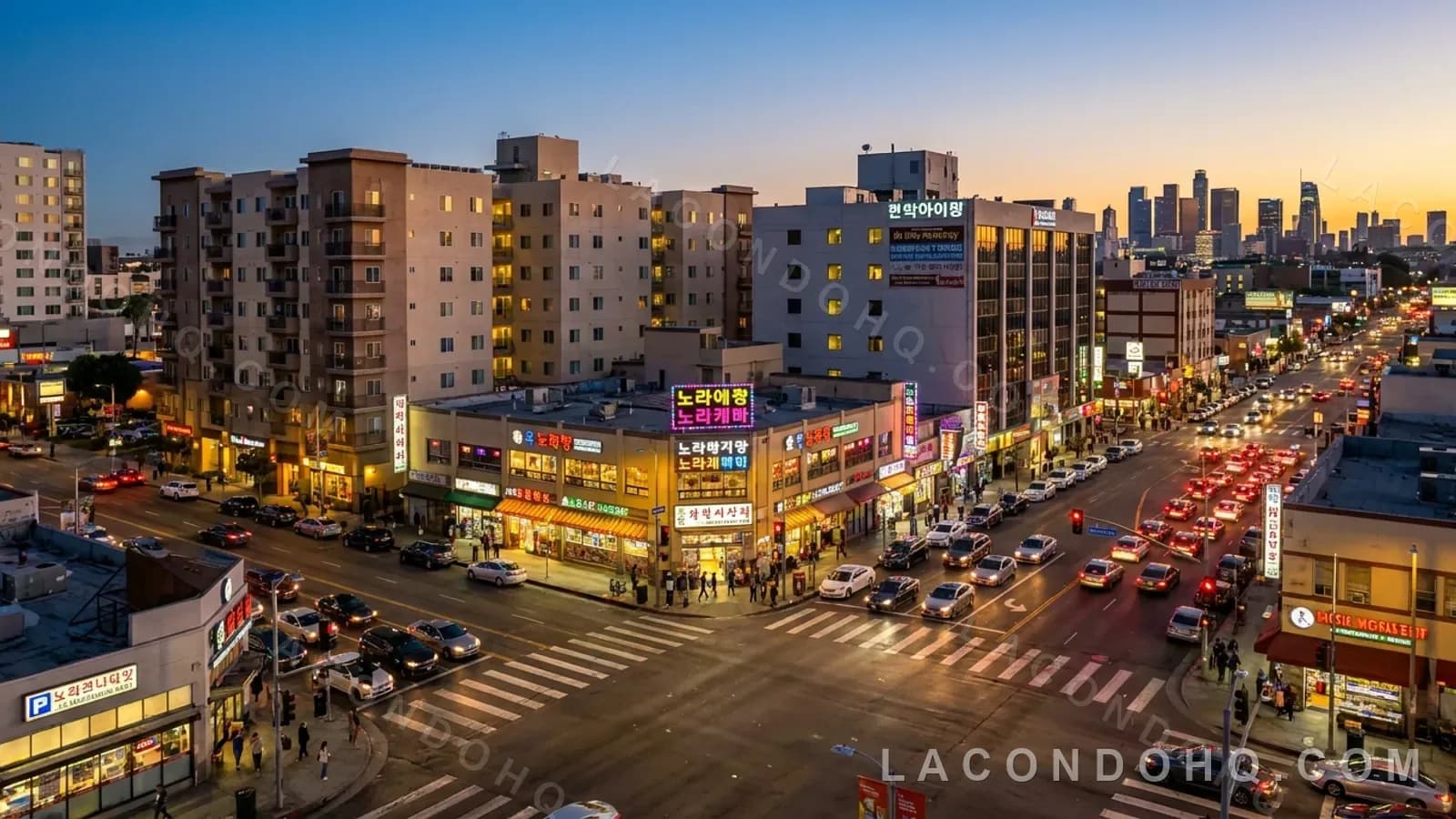
Koreatown's 491 amenities include 205 places to eat and drink, 17 grocery options, 151 transit stops, 92 everyday shops and 16 pharmacies and clinics. Only Downtown LA, with 788, counts more among the 29 neighborhoods we measure. The transit figure reflects Wilshire Boulevard: the Metro D Line runs beneath it and the B Line stops at Wilshire/Vermont, as our neighborhood guide at /neighborhoods/koreatown notes.
The weak spot is green space. Koreatown counts 4 parks or recreation spots, against 11 in Culver City and in Palms. If daily walks to a park matter to you, check the map on the walkability page against the block you are considering. Condo buildings we profile in the neighborhood are listed at /neighborhoods/koreatown/buildings.
Culver City: fifth, with its own city hall
Culver City counts 386 amenities: 136 places to eat and drink, 16 grocery options, 85 transit stops, 113 everyday shops, 11 parks or recreation spots and 19 pharmacies and clinics. That puts it 5th of 29, behind Downtown LA, Koreatown, Palms (463) and Sawtelle (417), and just ahead of Hollywood (378).
Culver City is its own incorporated city, not part of the City of Los Angeles, with a separate city government and school district. The Metro E Line's Culver City station sits at the northeast edge of downtown Culver City, with trains toward Downtown LA and Santa Monica, and the Ballona Creek Bike Path runs toward Marina del Rey. The neighborhood page is /neighborhoods/culver-city.
Highland Park: moderate, along the A Line
Highland Park counts 171 amenities: 54 places to eat and drink, 10 grocery options, 48 transit stops, 51 everyday shops and 4 parks or recreation spots, which ranks it 18th of 29. Its ten grocery options are more than Silver Lake, Los Feliz or West Hollywood count.
The Metro A Line stops at Highland Park station, at Marmion Way and Avenue 57, and North Figueroa Street carries most of the neighborhood's shops and restaurants. Much of the area is inside the Highland Park-Garvanza Historic Preservation Overlay Zone, so exterior changes go through City Planning review. See /neighborhoods/highland-park for the neighborhood guide.
Silver Lake and Echo Park: lake loops, fewer mapped stops
We measure Silver Lake and Echo Park as one neighborhood. It counts 129 amenities: 56 places to eat and drink, 5 grocery options, 27 transit stops and 36 everyday shops, ranking 20th of 29. That is the lowest of the four neighborhoods in this post, and its 27 transit stops are the fewest of the four.
The count does not capture what draws many people there on foot: the Silver Lake Reservoir path, about 2.25 miles, and Echo Park Lake. Metro Line 2 runs along Sunset Boulevard, and the B Line's Vermont/Sunset station sits at Silver Lake's western edge. The page is /neighborhoods/silver-lake/walk-score.
How the four compare with the rest of LA
Above all four sits Downtown LA, with 788 amenities, including the most places to eat and drink (314) and transit stops (247) of any neighborhood we measure. It does not lead every group: Palms counts more grocery options (20 to 18), Westwood more parks and recreation spots (22) and Santa Monica more pharmacies and clinics (42). Palms and Sawtelle, both on the Westside, rank 3rd and 4th, ahead of Culver City. At the other end, Sherman Oaks counts 59 around its centre, Pacific Palisades 44 and Hollywood Hills West 5, which says more about where their centre points fall than about every street in them.
Walkability is one input. Prices, rents and inventory differ just as much between these neighborhoods; the current asking figures for each are on /market-stats and on the neighborhood reports, such as /market-reports/culver-city and /market-reports/highland-park, where every figure carries its own date.
Questions buyers ask about walkable LA condo neighborhoods
Is Culver City walkable?
By our count, yes: 386 everyday amenities are mapped within about 1 km of its centre, including 136 places to eat and drink and 85 transit stops, which ranks it 5th of the 29 Los Angeles neighborhoods we measure, using OpenStreetMap data collected in October 2026.
Is Koreatown walkable?
Koreatown has the second-highest amenity count of the 29 LA neighborhoods we measure, 491 within about 1 km of its centre, behind only Downtown LA, with 205 places to eat and drink and 151 transit stops, though only 4 parks or recreation spots.
How walkable is Highland Park?
Highland Park counts 171 mapped amenities within about 1 km of its centre, which our pages describe as moderate density and rank 18th of 29, and it is served by the Metro A Line's Highland Park station at Marmion Way and Avenue 57.
Is Silver Lake or Echo Park walkable?
Our pages measure them as one neighborhood with 129 mapped amenities within about 1 km of the centre, moderate density and 20th of 29, though the counts do not include walking loops like the Silver Lake Reservoir path or Echo Park Lake.
Is this the same as a Walk Score?
No, LA Condo HQ licenses no third-party walkability score and publishes no rating; our pages show counts of mapped OpenStreetMap features with the method stated, so check any single building's own walk on a map before you buy.
What to check before you rely on a count
Open the walkability page for the neighborhood and look at the map, then walk the route from the building you are considering to the grocery and transit stop you would actually use. Check whether that building sits near the measured centre or at the neighborhood's edge. For individual buildings, the profiles under /buildings list nearby places with distances where our research has sourced them.
Sources and review scope
Sources checked 2026-11-11. The notes identify which facts each publication supports.
- LA Condo HQ — How walkable is Koreatown? (read November 11, 2026; data collected October 2026)
Koreatown: 491 amenities within about 1 km (205 eat and drink, 17 grocery, 151 transit, 4 parks), very high density, 2nd of 29 LA neighborhoods measured.
- LA Condo HQ — How walkable is Culver City? (read November 11, 2026; data collected October 2026)
Culver City: 386 amenities (136 eat and drink, 16 grocery, 85 transit, 113 shops, 11 parks, 19 pharmacies and clinics), 5th of 29; method and density bands; OpenStreetMap, ODbL.
- LA Condo HQ — How walkable is Highland Park? (read November 11, 2026; data collected October 2026)
Highland Park: 171 amenities (54 eat and drink, 10 grocery, 48 transit, 4 parks), moderate density, 18th of 29.
- LA Condo HQ — How walkable is Silver Lake & Echo Park? (read November 11, 2026; data collected October 2026)
Silver Lake & Echo Park: 129 amenities (56 eat and drink, 5 grocery, 27 transit, 1 park), moderate density, 20th of 29.
- LA Condo HQ — How walkable is Downtown LA? and Palms, Hollywood, Los Feliz pages (read November 11, 2026)
Downtown LA 788 amenities and 247 transit stops, highest of 29; Palms 463 (3rd), Hollywood 378 (6th), Los Feliz 189 (16th), from the same dataset.
- LA Condo HQ — neighborhood guides for Koreatown, Culver City, Highland Park and Silver Lake & Echo Park (read November 11, 2026)
Transit and civic facts: Metro A Line Highland Park station at Marmion Way and Avenue 57; Highland Park-Garvanza HPOZ; Culver City incorporated with its own government and E Line station; Silver Lake Reservoir path about 2.25 miles, Metro Line 2 and B Line Vermont/Sunset; Koreatown D Line and B Line at Wilshire/Vermont.
- OpenStreetMap — copyright and licence (ODbL)
Source and licence of the mapped points of interest counted on the walkability pages.
Written by
Publisher and editor, LA Condo HQ
LA Condo HQ is published by Eltherion, LLC. This article is not reviewed by a licensed real estate agent or broker and is not professional advice.