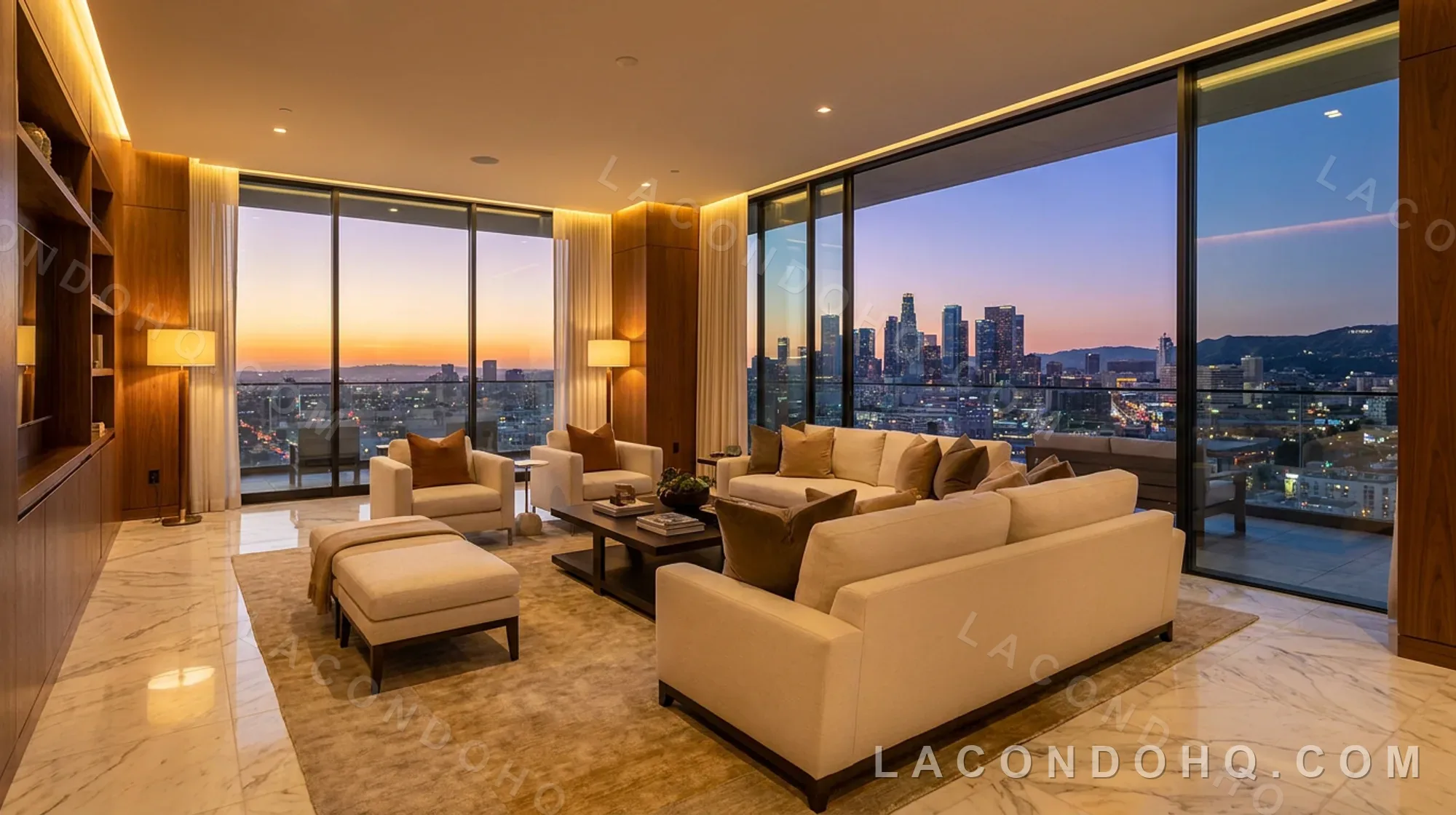
Current numbers, September 28, 2026
Condos listed on the MLS right now, refreshed every six hours.
| Neighborhood | For sale | Median asking | Median $/sq ft | For rent | Median rent |
|---|---|---|---|---|---|
| Downtown LA | 335 | $585K | $619 | 164 | $3,190/mo |
| Westwood | 119 | $1.19M | $745 | 95 | $5,495/mo |
| Koreatown | 132 | $695K | $603 | 206 | $2,500/mo |
Medians appear only when enough listings publish the figure; a dash means too few to report. Full neighborhood reports
In California, a condo board cannot impose special assessments totaling more than 5 percent of the fiscal year's budgeted gross expenses, or raise regular dues more than 20 percent over the prior year, without member approval. Those caps come from Civil Code section 5605. Emergency assessments under section 5610 are exempt from both.
Two numbers define a board's unilateral authority
The Davis-Stirling Act draws the line in one place. Without the approval of a majority of a quorum of members, a board may not levy special assessments that in the aggregate exceed 5 percent of the budgeted gross expenses for that fiscal year, and may not increase the regular assessment by more than 20 percent over the preceding fiscal year's figure.
Run the arithmetic on a real association and the cap is smaller than it sounds. A building operating on a $1.2 million annual budget can assess about $60,000 across all owners on the board's own authority. Split across 60 units that is roughly $1,000 each — enough for an unplanned plumbing repair, nowhere near enough for a facade, an elevator modernization or a balcony program. Anything at that scale requires either a member vote, a loan the members approve, or a reserve balance that was funded years earlier.
That is the useful way to read the 5 percent rule: it is not a shield against large assessments. It is a rule about who has to say yes.
The emergency exception, and its three grounds
Section 5610 lets a board levy an emergency assessment outside those limits, on three grounds only: an extraordinary expense required by a court order; an extraordinary expense necessary to repair or maintain the development where a threat to personal safety is discovered; and an extraordinary expense necessary for repair or maintenance that could not reasonably have been foreseen when the budget was prepared.
The third ground carries the weight. It requires the board to pass a resolution stating why the expense was not foreseeable, and that resolution has to be distributed with the notice of assessment. That document is the single most informative page an owner or buyer can read, because it is the board explaining, in writing, why the reserve study did not anticipate a bill the owners are now paying.
If you are handed an emergency assessment notice with no resolution attached, ask for it.
What actually triggers assessments in Los Angeles buildings
Three cost drivers show up repeatedly in this city, and each has a paper trail you can read before you buy.
Balcony and walkway inspections come first. SB 326 requires associations with buildings of three or more multifamily dwelling units to have exterior elevated elements — balconies, decks and walkways with walking surfaces more than six feet above ground — inspected by a licensed structural engineer or architect, with the first inspection due by January 1, 2025 and repeats every nine years. The inspector's findings feed the reserve study, so a report finding damage is a preview of an assessment. The detail is at /blog/sb-326-balcony-inspection-la-condos.
Seismic retrofit is second. Los Angeles requires retrofits of certain soft-story wood-frame and non-ductile concrete buildings, and in a condominium the association pays, which means the owners pay. What to ask a seller is covered at /blog/la-seismic-retrofit-condo-buyers.
Insurance is third, and it is the quiet one. Earthquake deductibles are written as a percentage of insured value rather than a flat dollar amount, so a covered event can still leave the association with a seven-figure gap it must assess. Your own HO-6 policy has a loss assessment provision that responds to some of that, often with a low default limit you can raise for very little. Read yours: /blog/la-condo-insurance-ho6-fair-plan.
The two documents that predict the next assessment
The reserve study and the annual budget report. California requires an association to conduct a visual inspection for its reserve study at least every three years and to review it annually, and to distribute an annual budget report — including the reserve funding plan — to members 30 to 90 days before the fiscal year ends.
Read them together and one question answers itself: is the funding plan actually funding the components, or is it deferring them into a future assessment? A study that lists a roof at the end of its useful life with no matching line in the funding plan is telling you what the next special assessment will be for. Percent-funded is the headline figure, but the component table is where the timing lives.
Who pays when an assessment lands mid-escrow
Timing decides this, and the documents record it. A special assessment that has been levied before closing is generally the seller's obligation for installments due before the closing date, with the buyer taking the ones after — but the allocation is negotiable and belongs in the purchase agreement rather than in an assumption.
The risk is the assessment that has been discussed but not yet levied. It does not appear on any statement of amounts due, because it does not exist yet. It appears in board minutes. Request the recent minutes through escrow along with the disclosure package and read them for the words "proposal", "bid", "engineer" and "reserve".
What this means in today's LA market
The median Los Angeles condo sells for $875K, or $689 per square foot, with about 1,950 active listings and 8.9 months of supply, as of August 4, 2026 in our report at /market-stats. Supply above six months is the range where buyers have room to make requests, and document production is a reasonable one.
It also means older stock is competing on price, and older stock is where the assessment questions concentrate. Downtown's converted and mid-century inventory at /neighborhoods/downtown-la and the Wilshire Corridor towers around /neighborhoods/westwood carry the building ages where facade, plumbing and elevator cycles come due. We profile 286 Los Angeles condo buildings at /buildings, and every one of them has an association with a reserve position worth reading.
We are a research directory rather than a brokerage: we do not list on the MLS, negotiate offers or close transactions. When you want an association's budget, reserve study and minutes read properly on a specific unit, we introduce you to a licensed partner agent.
Questions LA condo buyers ask about special assessments
How large a special assessment can a California condo board levy without an owner vote?
Special assessments totaling more than 5 percent of the fiscal year's budgeted gross expenses require the approval of a majority of a quorum of members, under Civil Code section 5605. The same section caps a regular dues increase at 20 percent over the prior year without that approval. Emergency assessments under section 5610 are exempt from both limits.
What counts as an emergency assessment in California?
Only three things: an extraordinary expense required by a court order, an extraordinary expense necessary to repair or maintain the development where a threat to personal safety is discovered, and an extraordinary expense that could not reasonably have been foreseen when the budget was prepared. The third requires a written board resolution explaining why, distributed with the assessment notice.
Can I find out about a pending special assessment before I buy?
Partly. An assessment already levied appears in the escrow disclosure package, but one still under discussion appears only in board meeting minutes and in the gap between the reserve study's component list and the funding plan. Request recent minutes along with the reserve study and read both before your contingencies expire.
Does the seller or the buyer pay a special assessment?
Installments due before closing are generally the seller's and those after are generally the buyer's, but the allocation is negotiable and should be written into the purchase agreement rather than assumed. If an assessment is levied while you are in escrow, raise it immediately rather than at closing.
Why are LA condo assessments tied to balconies and earthquakes?
Two California requirements drive it. SB 326 requires periodic inspection of balconies, decks and elevated walkways by a licensed engineer or architect, and repairs found are association expenses. Separately, earthquake deductibles are a percentage of insured value rather than a flat sum, so even a covered loss can leave a gap the association must assess.

Written by
LA Condo HQ
Real-estate research publisher
LA Condo HQ is published by Eltherion, LLC to help readers research Los Angeles buildings, neighborhoods and real-estate decisions. We publish source notes, ownership guides and practical tools, and help readers request introductions to licensed partner agents. We are not a licensed brokerage.