
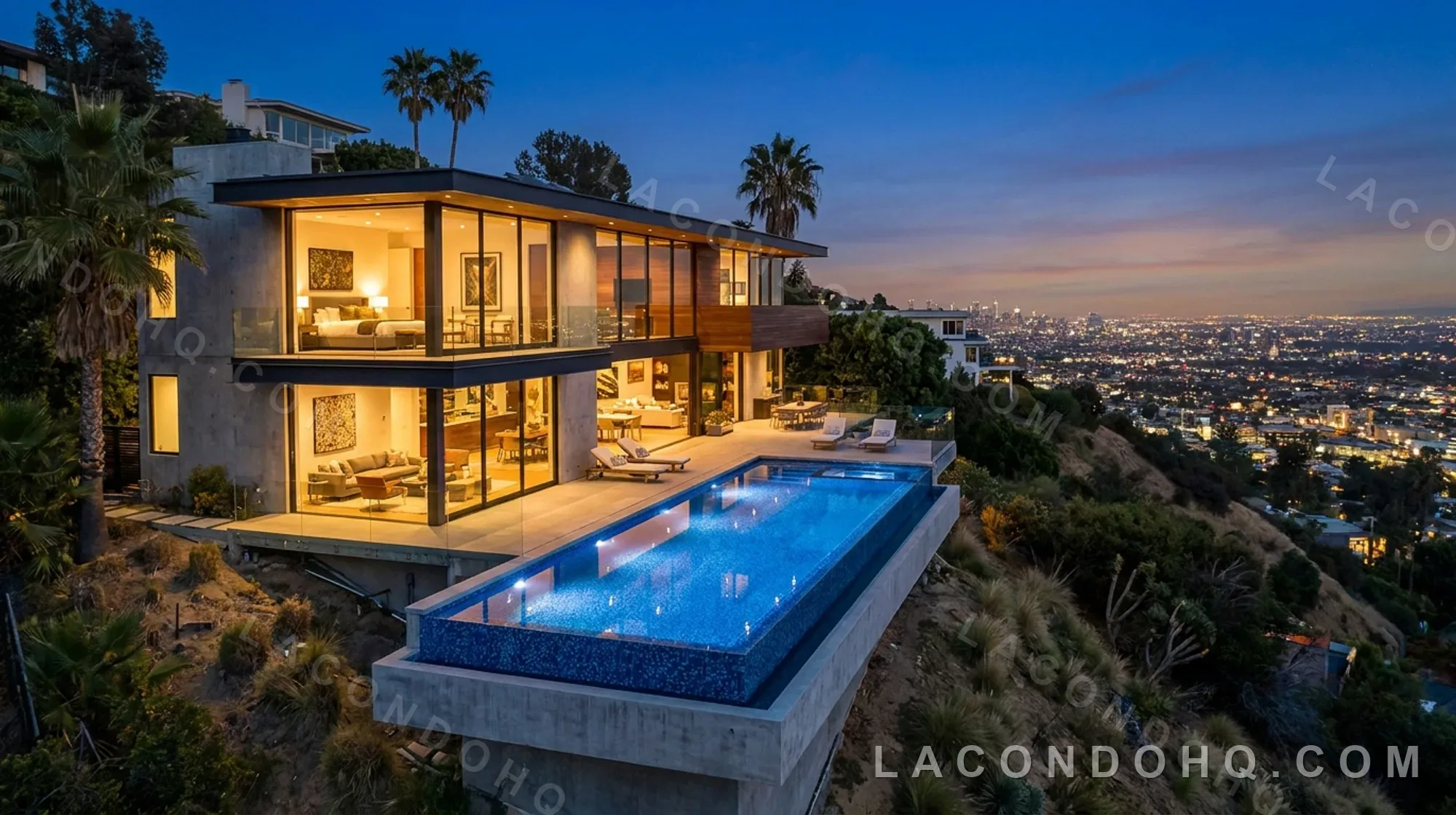
Current numbers, September 28, 2026
Condos listed on the MLS right now, refreshed every six hours.
| Neighborhood | For sale | Median asking | Median $/sq ft | For rent | Median rent |
|---|---|---|---|---|---|
| Century City | 44 | $2.25M | $1,179 | 25 | $11,500/mo |
| Beverly Hills | 70 | $1.91M | $905 | 83 | $5,500/mo |
Medians appear only when enough listings publish the figure; a dash means too few to report. Full neighborhood reports
As of September 26, 2026, the median asking price on condo listings in Century City was about $2.25 million, roughly $1,179 per square foot (/market-reports/century-city), against about $1.9 million and roughly $892 per square foot in Beverly Hills (/market-reports/beverly-hills). So on current asking prices it is Century City, not the more famous 90210, that costs more, and by nearly a third per foot.
The price gap runs opposite to the address gap
Beverly Hills is the more famous name by an enormous margin, and the price difference does not match the reputation difference. On those September 26 figures, Century City's median asking price was about eighteen percent higher than Beverly Hills', and its median price per square foot was roughly thirty-two percent higher. Read those two numbers together and they tell you something specific: a Beverly Hills condo listing tends to give you more space for the money, while Century City's premium reflects its towers, their views and full-service operations. What Beverly Hills offers instead is the 90210 address, the city services and the school district.
These are asking prices on listings published on LA Condo HQ, not closed sales, and they move week to week. The citywide medians, price per square foot, inventory and days-on-market are on our live report at /market-stats, and current inventory is at /condos-for-sale.
Vertical by design versus vertical by exception
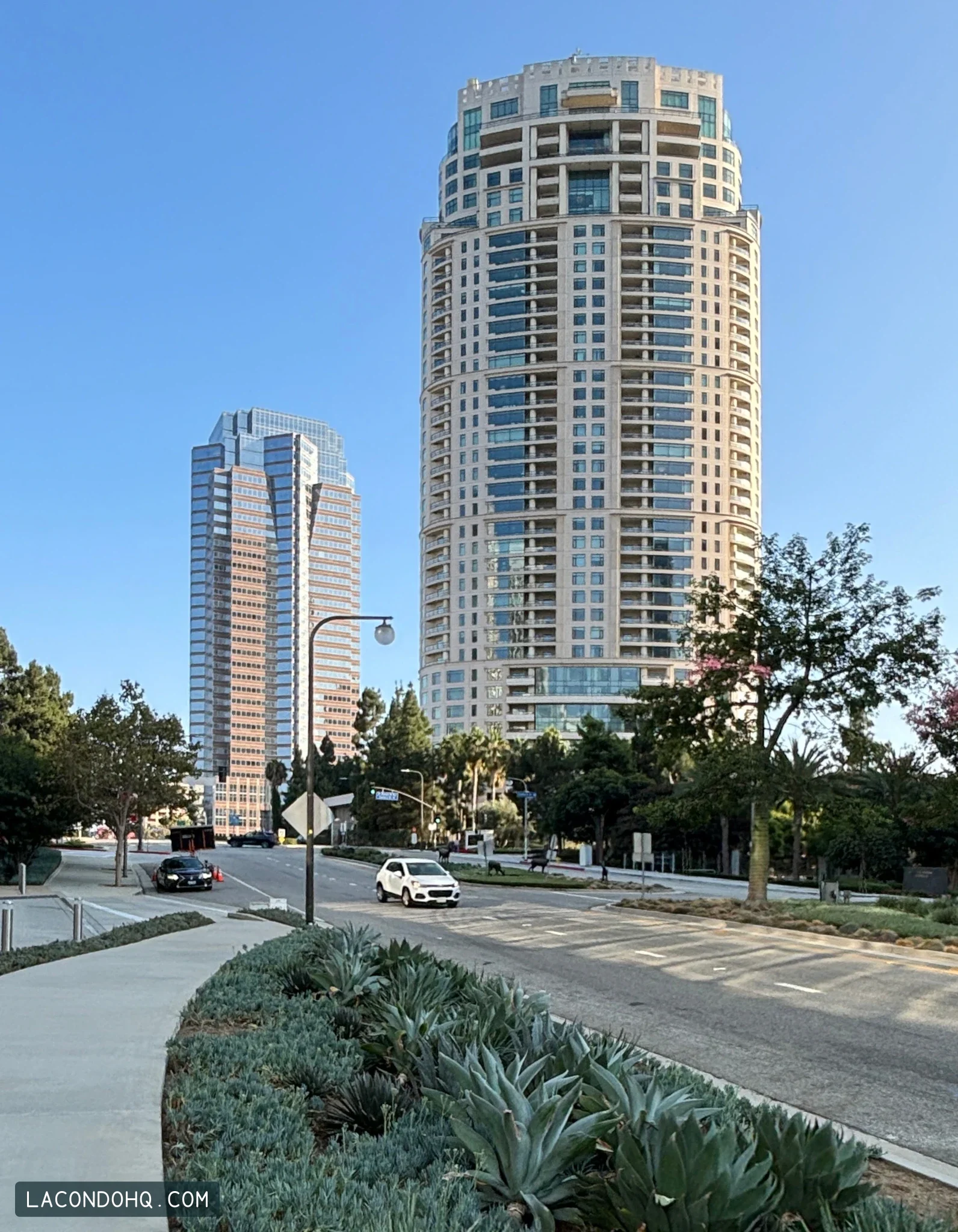
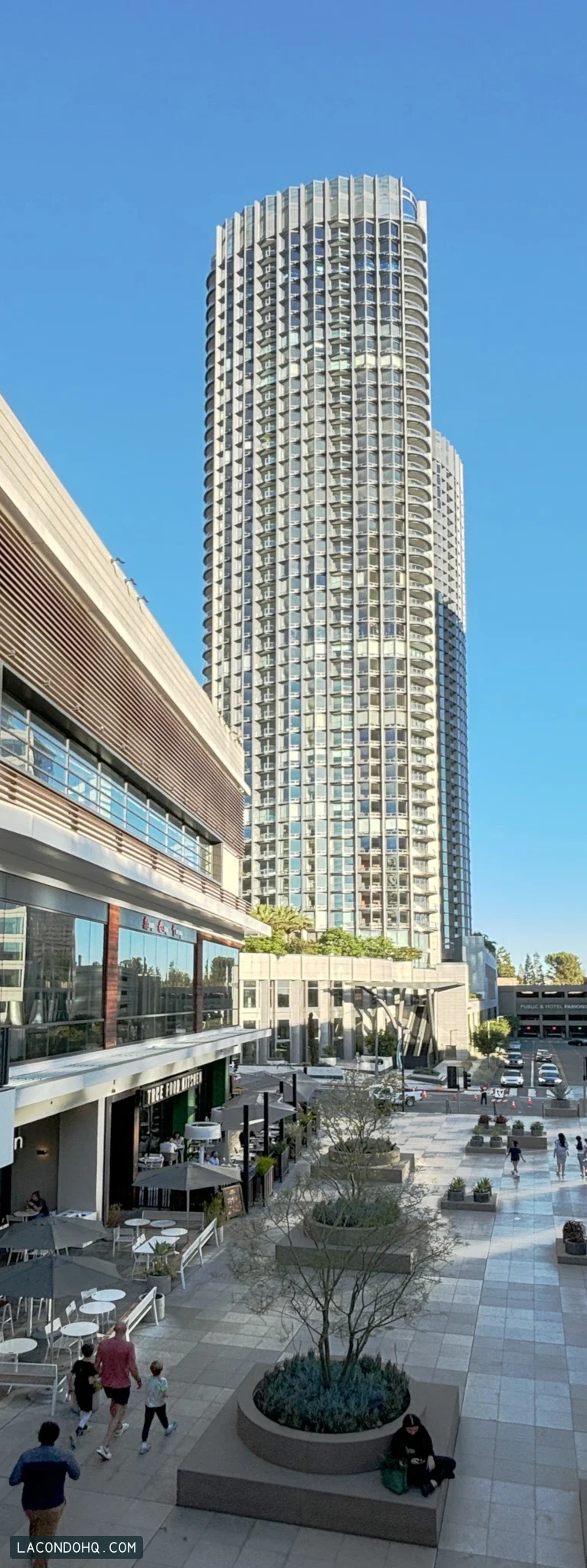
The two markets differ structurally, not just in price. Century City was planned as a high-rise district on the former 20th Century Fox backlot, and our research describes its housing stock as overwhelmingly vertical: full-service towers plus gated low-rise communities like Century Hill and Century Woods, with true single-family houses essentially nonexistent inside the district. If you want a condo there, you are shopping the mainstream product.
Beverly Hills is the reverse. Our research describes a city that skews heavily toward single-family estates — the flat grid of the Flats, the hillside Trousdale Estates — with condominiums concentrated in a defined tier along Wilshire Boulevard's Condo Canyon and around the business triangle. Buying a condo in Beverly Hills means buying into the exception rather than the rule.
The buildings each market actually offers
Century City includes condominium buildings and managed rental towers, which need different comparisons. Start with the retained profile at /buildings/the-century for that condominium’s source notes. Ten Thousand advertises rental inquiries through its leasing office; its rent and services should not be described as condominium purchase prices or HOA dues. For any residence being offered for sale, obtain its own budget, charge schedule and ownership documents.
Beverly Hills condo product is named rather than numerous: our neighborhood research points to Condo Canyon on Wilshire and cites The Carlyle and Sierra Towers nearby as the recognizable full-service addresses. The amenity promise is similar. The difference is how many doors it comes behind.
Two city halls, and why that matters at the closing table
This is the difference buyers most often miss. Beverly Hills is an independent incorporated city with its own police department, city government and the Beverly Hills Unified School District. Century City, for all its separate identity, sits inside the City of Los Angeles.
That distinction has a direct cost consequence on a sale: the City of LA's Measure ULA transfer tax reaches high-value transactions in Century City and does not apply in Beverly Hills, because Beverly Hills is not the City of LA. On the price points these two markets trade at, that is not a rounding error — it is a line item worth modeling before you choose a side, particularly if you expect to sell within a few years. The thresholds, the rates and the Prop 13 mechanics underneath them are laid out at /blog/la-condo-property-taxes-prop-13-measure-ula.
Everything else legal is shared. Both sit under California's Davis-Stirling Act, so the association budget, reserve study, minutes and disclosure packet are documents you are entitled to demand in either city — the framework is at /blog/davis-stirling-act-la-condo-buyers.
What our directory can and cannot show you
Be careful reading selection from any single source, ours included. On September 26, 2026, LA Condo HQ showed 71 Beverly Hills condos listed for sale against 44 in Century City, so a larger city with a narrow condo tier can still put more units on the market at a given moment than a compact tower district. The building counts do not compare cleanly: our directory's Beverly Hills building coverage is currently thin — one profiled building against Century City's 22 — and that is a fact about our coverage, not about the city's stock, which our own neighborhood research describes as a full Condo Canyon tier. Use /neighborhoods/beverly-hills and /neighborhoods/century-city for the neighborhood picture and treat the building directory as still filling in on the Beverly Hills side.
Which buyer should choose which
Choose Century City if you want a district built around full-service high-rise living and a lock-and-leave building minutes from Beverly Hills, Westwood and the 405 — and you are willing to pay the higher asking price per foot, carry high dues and, on eventual resale, a City of LA transfer tax. Choose Beverly Hills if the address, the independent city services and the school district are the point, you want walkability to Rodeo Drive rather than to a mall, and you accept that condos there are the exception in a city of estates.
Neither is a compromise. They are two answers to a question about what you are actually buying: a building, or a city. If Century City is on your list, the neighboring comparison worth reading next is at /blog/westwood-vs-century-city-condos; if Beverly Hills is, it is at /blog/west-hollywood-vs-beverly-hills-condos. When you have narrowed to a specific building, that is the moment to pull its documents — and we will introduce you to a licensed partner agent to do it.
Questions buyers ask about Century City and Beverly Hills
Is Beverly Hills more expensive than Century City?
Not on current asking prices. As of September 26, 2026, the median asking price on condo listings in Century City was about $2.25 million, roughly $1,179 per square foot, against about $1.9 million and roughly $892 per square foot in Beverly Hills, so Century City asked about eighteen percent more on the median and roughly thirty-two percent more per foot. These are asking prices on listings published on LA Condo HQ, not closed sales.
Does Measure ULA apply in Beverly Hills?
No. Beverly Hills is an independent incorporated city with its own government, so the City of Los Angeles transfer tax known as Measure ULA does not reach sales there. Century City sits inside the City of LA, so it does. On the price points these markets trade at, that is a real line item to model before choosing a side, especially if you may sell within a few years.
Which has more condos to choose from?
It depends on what you count. On September 26, 2026, LA Condo HQ showed 71 Beverly Hills condos listed for sale against 44 in Century City, while our building directory profiles 22 Century City condo buildings and, so far, only one in Beverly Hills. Century City was planned as a high-rise district and its housing stock is overwhelmingly vertical, while Beverly Hills skews to single-family estates with condos concentrated along Wilshire's Condo Canyon and the business triangle.
How should I compare Century City ownership costs?
Use the budget and charge schedule for the exact condominium, and ask which services, reserves and assessments apply. Ten Thousand operates a rental leasing office, so it should not be used as an example of a condominium HOA bill.
Do the same HOA disclosure rules apply in both?
Yes. Both fall under California's Davis-Stirling Act regardless of which city governs the streets outside, so you are entitled to the association's budget, reserve study, meeting minutes and disclosure packet before closing in either market. The difference between the two cities is municipal — police, schools, transfer tax — not associational.
Sources and review scope
Sources checked 2026-09-06. The notes identify which facts each publication supports.
- Published property identity — Ten Thousand
Ten Thousand’s official contact publication gives 10000 Santa Monica Boulevard and explicitly identifies a leasing office, scheduled tours and rental inquiries.

Written by
LA Condo HQ
Real-estate research publisher
LA Condo HQ is published by Eltherion, LLC to help readers research Los Angeles buildings, neighborhoods and real-estate decisions. We publish source notes, ownership guides and practical tools, and help readers request introductions to licensed partner agents. We are not a licensed brokerage.


,_Avenue_of_the_Stars_(Century_City)_Sept._2024.jpg)
_from_Westfield_Century_City.JPG)